

NMDA & GABAA Receptors
At the Mu Lab at Case Western Reserve University, we research the molecular mechanisms underlying the folding, assembly and degradation of NMDA and GABAA receptors.


What are we studying, and why?
N-methyl-D-aspartate receptors (NMDARs) are glutamate-gated cation channels that mediate excitatory neurotransmission and are critical for synaptic development and plasticity in the central nervous system (CNS). Functional NMDARs typically form via the heterotetrametric assembly of GluN1 and GluN2 subunits. Genetic variants in the subunits are implicated in various neurodevelopmental and neuropsychiatric disorders, including Alzheimer’s disease, Parkinson’s disease, neuropathic pain, and epilepsy.
Gamma-aminobutyric acid type A receptors (GABAARs) are ligand-gated anion channels that mediate inhibitory neurotransmission and are thought to play a major role in controlling anxiety, stress and fear. Genetic variants in the subunits of GABAARs are involved in the onset of multiple pathological conditions, including genetic epilepsy, anxiety disorders, mood disorders, and schizophrenia. Mutated GABAARs containing insufficient or incorrectly folded subunits have reduced channel function, which often leads to childhood absence epilepsy and febrile seizure.
Understanding the folding and misfolding of both NMDA and GABAA receptors is crucial in identifying potential therapies for these conditions. Currently, there are no cases of personalized medicine that target these receptors, even though they are major therapeutic targets for epilepsy and many other neurological indications.
So, what are our aims?
The Mu laboratory aims to understand protein homeostasis of membrane proteins. To function, membrane proteins need to fold into their native structures and assemble properly in the endoplasmic reticulum (ER) for subsequent trafficking to the plasma membrane or their intended destinations in a fully functional state. Mutations in a given protein could lead to protein misfolding and excessive ER-associated degradation (ERAD), and thus a significantly lowered concentration of proteins in their functional locations.
Currently, the Mu lab focuses on neurotransmitter-gated ion channels, GABAARs and NMDARs. They mediate the excitation/inhibition balance in the mammalian central nervous systems. Their functional defect leads to epilepsy, autism, intellectual disability, and other neurodevelopmental diseases.
The Mu lab explores how molecular chaperones, folding enzymes, ERAD factors, and trafficking factors, coordinate to facilitate membrane protein folding, assembly, degradation and trafficking. We also use small molecule protein homeostasis regulators to correct pathogenic membrane proteins with protein conformational deficiency, as a therapeutic strategy to treat corresponding diseases.
2022 Research Poster – Studied GABAAR interacting proteins: RCN2 and TECR

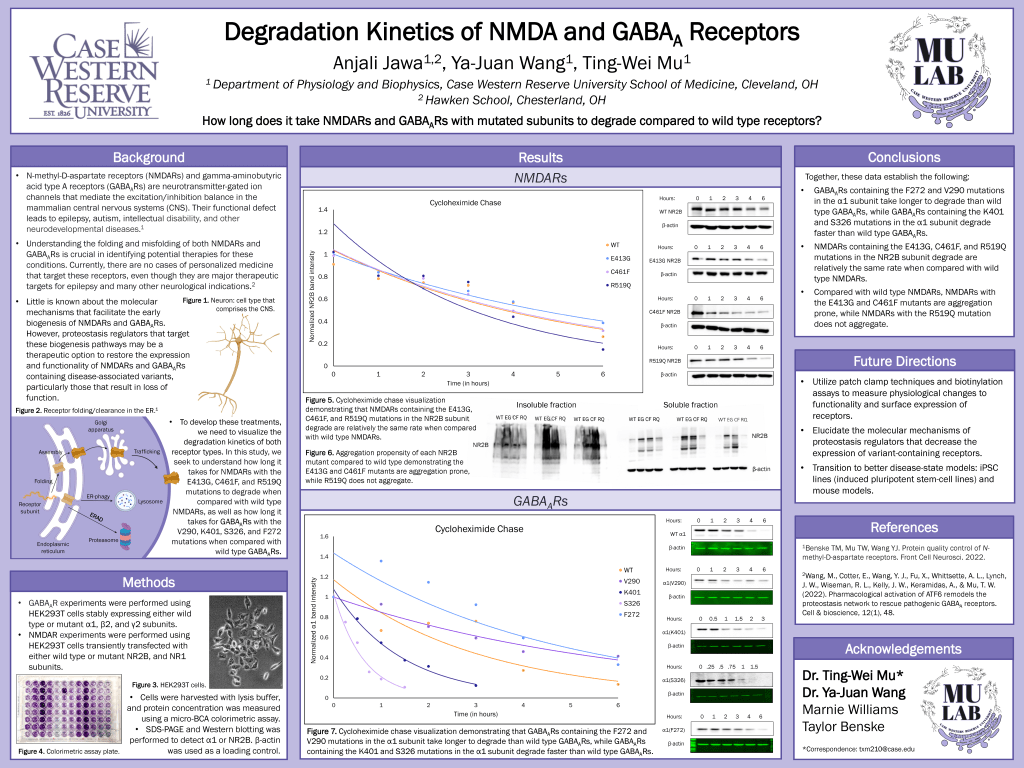
2023 Research Poster – Studied degradation kinetics of NMDARs and GABAARs
 Anjali Jawa